United Nations has published an interesting report that says more Indians have access to a mobile phone, as compared to basic sanitation faciilty, i.e. toilet.
India has some 545 million cell phones, enough to serve about 45 per cent of the population, but only about 366 million people or 31 per cent of the population had access to improved sanitation in 2008.
..the UNU report cites a rough cost of $300 to build a toilet, including labour, materials and advice. – source
WHO and UNICEF predict that if the global trend continues, there will be a shortfall of 1 billion persons from that sanitation goal by the target date of 2015.
While this may come as a surprise to some, this also brings an important step forward – bring more private-public partnership in such sectors where government alone has failed to bring significant impact.
What’s your opinion?
Wednesday, June 23, 2010

DTH Industry in India : Past, Present and Future
India has a total television population of close to 135 million, out of which 80% have access to cable and satellite (i.e. 108 million). The total DTH subscribers are close to 22 million. Thus the DTH has a market share of approximately 20%. The subscriber base for DTH in 2006 was meager 1 million. Now for an industry which is just 5 years old, it is a great achievement.
Let’s have a look at how the DTH industry has grown in these 5 years. In 2005 Dish TV was the only player in the DTH industry and was registering subscriber growth mainly in the areas where cable TV was not available. The subscribers were not ready for the cost of set top box. In 2007 CAS mandate was introduced in selected metro cities, where users had to invest in a set top box.
Though the initiative was not very successful, it gave a wider acceptance to the DTH and consumer became ready to pay for the set top box. Spotting the opportunity Sun Direct launched its services in 2007 with a drastically low one time cost involved for DTH subscriber. Followed by this Reliance, Big TV and Air-Tel and Videocon launched their services. The market became competitive. Every player came with innovative offerings, Dish TV offered Movie on Demand free worth the cost of set top box, Air-Tel and Big TV offered free subscription for first few months etc. All these things were coupled with aggressive marketing campaigns. Tata Sky gained the maximum subscribers during this period.
Today the market shares of various players are as follows
DishTV : 30%
Sun Direct: 25%
Tata Sky: 22%
BIG TV : 13%
Airtel : 8%
D2H : 2%
So where is the real growth happening for the DTH industry. Is it the urban areas or rural? Though DTH is comparatively expensive than cable service, the growth is coming from the rural area. If we see statistics the growth for the digital segment in rural areas were 34%, 49% and 64% in the past three years.(source:- TAM Annual Universe Update –2010). The growth in the rural segment can be attributed to frequent power cuts in the rural areas. DTH platform gives the rural consumer access to their favorite programs, with the help of generator/ invertors, which is not possible with the cable service in most of the areas.
Though DTH has certain advantages such as better picture/ sound quality, better customer service. It also has a disadvantage of price. The DTH player have to pay various taxes such as Adjusted gross receipts @ 10%, service tax @ 12.36%,VAT @ 12.5%,CST@3%,corporate tax, Excise duty@ 16%, Customs duty, CVD ,customs duty etc. Whereas the local cable operators easily get away with government taxes by underreporting the subscriber base. Thus gaining a clear cost advantage. The regulator should take a note for the same and provide regulations for the same.
At the same time in Indian market “One size fits all” strategy doesn’t work for long. So, the DTH players have to design packages suitable for rural consumer enable them to enjoy the digital content (For eg. Levi’s jeans had enabled consumers to buy their jeans with an EMI scheme).
The DTH industry is expected to grow at a CAGR of close to 24% .The future of DTH industry will largely depend on innovative marketing tactics adopted by the DTH players. The stage is all set for DTH industry. Let the real game begin.
Let’s have a look at how the DTH industry has grown in these 5 years. In 2005 Dish TV was the only player in the DTH industry and was registering subscriber growth mainly in the areas where cable TV was not available. The subscribers were not ready for the cost of set top box. In 2007 CAS mandate was introduced in selected metro cities, where users had to invest in a set top box.
Though the initiative was not very successful, it gave a wider acceptance to the DTH and consumer became ready to pay for the set top box. Spotting the opportunity Sun Direct launched its services in 2007 with a drastically low one time cost involved for DTH subscriber. Followed by this Reliance, Big TV and Air-Tel and Videocon launched their services. The market became competitive. Every player came with innovative offerings, Dish TV offered Movie on Demand free worth the cost of set top box, Air-Tel and Big TV offered free subscription for first few months etc. All these things were coupled with aggressive marketing campaigns. Tata Sky gained the maximum subscribers during this period.
Today the market shares of various players are as follows
DishTV : 30%
Sun Direct: 25%
Tata Sky: 22%
BIG TV : 13%
Airtel : 8%
D2H : 2%
So where is the real growth happening for the DTH industry. Is it the urban areas or rural? Though DTH is comparatively expensive than cable service, the growth is coming from the rural area. If we see statistics the growth for the digital segment in rural areas were 34%, 49% and 64% in the past three years.(source:- TAM Annual Universe Update –2010). The growth in the rural segment can be attributed to frequent power cuts in the rural areas. DTH platform gives the rural consumer access to their favorite programs, with the help of generator/ invertors, which is not possible with the cable service in most of the areas.
Though DTH has certain advantages such as better picture/ sound quality, better customer service. It also has a disadvantage of price. The DTH player have to pay various taxes such as Adjusted gross receipts @ 10%, service tax @ 12.36%,VAT @ 12.5%,CST@3%,corporate tax, Excise duty@ 16%, Customs duty, CVD ,customs duty etc. Whereas the local cable operators easily get away with government taxes by underreporting the subscriber base. Thus gaining a clear cost advantage. The regulator should take a note for the same and provide regulations for the same.
At the same time in Indian market “One size fits all” strategy doesn’t work for long. So, the DTH players have to design packages suitable for rural consumer enable them to enjoy the digital content (For eg. Levi’s jeans had enabled consumers to buy their jeans with an EMI scheme).
The DTH industry is expected to grow at a CAGR of close to 24% .The future of DTH industry will largely depend on innovative marketing tactics adopted by the DTH players. The stage is all set for DTH industry. Let the real game begin.
Voice Blogging Service by Airtel – 2 million users in 3 months [Voice is a Commodity]
Bharti Airtel has officially unveiled its voice-blogging service now enabling Airtel subscribers to share recorded voice updates with their friends and family members.
This service (powered by Bubblemotion) has been there for few months now; the company claims to have roped in two million users in the first three months of its soft launch and is currently the world’s fastest growing voice-oriented social networking service. (via). Airtel has also roped in some celebrities to promote its voice blogging by setting up their blogs on this platform.
How Airtel Voice Blogging Works
To subscribe to a voice-blogger and follow their updates, simply dial *short-code* (for example *5000* for Amitabh Bachchan, or *91xxxxxxxx* for a friend.)
To launch a voice-blog (free), just dial *7* and follow the prompts.
When status updates are recorded, followers will receive free SMS notifications, and will be prompted to dial *2* to listen to the updates in their Airtel Blog inbox.
Standard airtime charges apply.
To follow celebrities on Airtel Blog, customers simply dial the *short-code* of the voice-blogger they want to hear on their Airtel mobile. As of now, following celebrities have their voice blog set up on Airtel:
Amitabh Bachchan: *5000*
Arshad Warsi: *5201*
Lara Dutta: *5148*
Neetu Chandra *5147*
VJ Ranvijay – Ranvijay: *5021*
Sonu Nigam: *5030*
Out of curiosity dialed the number of Amitabh Bachchan and got to listen to his “jeevan ki kahani”, the numbers and the service worked fine during my trial with the process. Through this offering, Airtel aims to take micro-blogging to a new level all together.
Voice is a Commodity?
Though the concept is innovative, but am wondering on the feasibility of this overall service.
Somehow listening to celebs updates in their own voice might seem interesting but for a normal user recording your updates by dialing some number and then sending updates via SMS notification does not seem to be quick and simple process. Few months back, Airtel had launched an offering in micro-blogging area by integrating its sms through Twitter. In fact I was one of those users who had opted for SMS-Twitter service (paid SMS route) but the interest faded away in texting my tweet within few days of usage only. As of now, not sure of the scalability of this new offering from Airtel but would not like to pass on a clear judgment on this, as you never know what can click in the world of social networking and micro-blogging in India.
The attempt is obviously to maximize air waves (voice is a commodity these days) and monetize via premium service.
This service (powered by Bubblemotion) has been there for few months now; the company claims to have roped in two million users in the first three months of its soft launch and is currently the world’s fastest growing voice-oriented social networking service. (via). Airtel has also roped in some celebrities to promote its voice blogging by setting up their blogs on this platform.
How Airtel Voice Blogging Works
To subscribe to a voice-blogger and follow their updates, simply dial *short-code* (for example *5000* for Amitabh Bachchan, or *91xxxxxxxx* for a friend.)
To launch a voice-blog (free), just dial *7* and follow the prompts.
When status updates are recorded, followers will receive free SMS notifications, and will be prompted to dial *2* to listen to the updates in their Airtel Blog inbox.
Standard airtime charges apply.
To follow celebrities on Airtel Blog, customers simply dial the *short-code* of the voice-blogger they want to hear on their Airtel mobile. As of now, following celebrities have their voice blog set up on Airtel:
Amitabh Bachchan: *5000*
Arshad Warsi: *5201*
Lara Dutta: *5148*
Neetu Chandra *5147*
VJ Ranvijay – Ranvijay: *5021*
Sonu Nigam: *5030*
Out of curiosity dialed the number of Amitabh Bachchan and got to listen to his “jeevan ki kahani”, the numbers and the service worked fine during my trial with the process. Through this offering, Airtel aims to take micro-blogging to a new level all together.
Voice is a Commodity?
Though the concept is innovative, but am wondering on the feasibility of this overall service.
Somehow listening to celebs updates in their own voice might seem interesting but for a normal user recording your updates by dialing some number and then sending updates via SMS notification does not seem to be quick and simple process. Few months back, Airtel had launched an offering in micro-blogging area by integrating its sms through Twitter. In fact I was one of those users who had opted for SMS-Twitter service (paid SMS route) but the interest faded away in texting my tweet within few days of usage only. As of now, not sure of the scalability of this new offering from Airtel but would not like to pass on a clear judgment on this, as you never know what can click in the world of social networking and micro-blogging in India.
The attempt is obviously to maximize air waves (voice is a commodity these days) and monetize via premium service.
Airtel app store sees 13 million downloads in four months
Bharti Airtel has announced that its applications store Airtel App Central, has seen 13 million application downloads within four months of its launch. Airtel says that on average its mobile subscribers downloaded at the rate of 1.2 applications per second over four months.Bharti Airtel had forayed into the -growing mobile applications market by launching Airtel App Central in February. It had claimed more than 2.5 million application downloads within 30 days of launching the store.
While in March the company's app store had over 1,500 apps available for download across over 550 devices, today the operator offers more than 71,000 apps for download across 780 mobile devices.
Atul Bindal, president, mobile services, Bharti Airtel, said in a statement, “Airtel customers have identified our easy single click purchase mechanism as the most popular aspect of the store. With over 32 per cent of downloads paid for, App Central is also emerging as the preferred destination for existing and upcoming developers in India and the world over.”
Airtel’s mobile customers can choose from apps in 25 categories, including social networking, games, business, news, sports, health, education and travel. Customers can visit Airtel Live on their mobile phones to browse App Central, or SMS a toll free number to receive App Central’s URL.
While in March the company's app store had over 1,500 apps available for download across over 550 devices, today the operator offers more than 71,000 apps for download across 780 mobile devices.
Atul Bindal, president, mobile services, Bharti Airtel, said in a statement, “Airtel customers have identified our easy single click purchase mechanism as the most popular aspect of the store. With over 32 per cent of downloads paid for, App Central is also emerging as the preferred destination for existing and upcoming developers in India and the world over.”
Airtel’s mobile customers can choose from apps in 25 categories, including social networking, games, business, news, sports, health, education and travel. Customers can visit Airtel Live on their mobile phones to browse App Central, or SMS a toll free number to receive App Central’s URL.
Sunday, June 6, 2010
How fast is 3G and what is 3.5G and when will 4G really be here?
Most 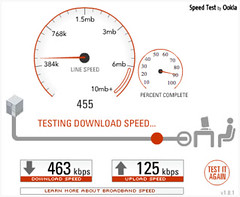 enterprise CTOs are very interested in the “cloud” and ways to tap into cloud-based resources. An interesting aspect of this discussion has been how to access the cloud while on the move. Today’s cellular networks support that access today, and future enhancements are making that support even better and much much faster.
How much faster? I’ll try to put that in context in this post.
Early 3G networks had a download speed of 384kbits per second and an upload speed of 192Kbits per second. The wireless router you might have in your home, by contrast, might have a speed of 54Mbits per second. So, about 140 times faster.
But the 3G networks in place today use new transmission algorithms that enable much faster throughput. Here is a little more context from vendor pages:.
Verizon asserts their broadband access, based on CDMA2000 1x EVDO (Code Division Multiple Access Evolution-Data Only) provides download speeds of up to 1.4Mbits/s and uploads of up to 800kbits/s.
AT&T is leveraging its GPRS technology called EDGE to deliver higher speeds than Verizon’s. AT&T’s EDGE delivers speeds of around 1.7Mbits/s and upload of around 1.2Mbits/s. AT&T also claims that their new protocols (HSDPA/UMTS, for High Speed Downlink Packet Access/Universal Mobile Telephone System) makes it possible to make use of more services and credit this with their ability to let you talk and use the Internet at the same time.
Sprint asserts that its broadband cards delivery 350-500kbps but then say you might get a peak of 3.1Mbps. I wonder if or how often that happens. Sprint also claims that they “lead the way with 4G” and in many ways they seem to be the pioneers here, but they might be defining that term differently than others. Clearly their offering of EVO is revolutionary, it is an incredible device (look for reviews elsewhere on our site). Sprint’s system, which is fast at an advertised .5 to 1.5 Mbps uplink (and peak uplinks at up to 5 Mbps (another source said peak can be 12 Mbps)), is very fast but still no where near the speed I think of when I think 4G.
Really 4G refers to the fourth generation of cellular wireless standards. I consider 4G to be IP-packet-switched networks operating at gigabit speed for access. Most in the field consider WiMAX and LTE (Long term evolution cell) as pre-4G or sometimes 3.5G.
What’s coming next:
A key emerging protocol is HSDPA (High-Speed Downlink Packet Access). HSDPA is sometimes called 3.5G. This protocol is in the HSPA (High Speed Packet Access) family and allows download of up to 14.4Mbits/s download and 5.8Mbits/s upload. Now this is getting interesting.
HSPA+ allows speeds of up to 42Mbits/s. This is almost what you would expect to see in your home wireless LAN. The next step is a project called Long Term Evolution. This LTE will start with providing 150Mbits/s to handheld devices and soon thereafter expect protocols and algorithms to increase that up to 1gig of bits per second to your mobile device.
When will these new protocols and speeds be available to consumers? The answer is, the best roadmaps I have seen are all tightly held insider views, but if you look at what is being rolled out right now we should expect a continuing stream of announcements that brings the timing of these new protocols more into focus. Public information show many vendors moving to the first version of LTE by 2011. Sprint’s very fast WiMax and cell is available in many urban areas today and will hopefully spread fast.
So, brace yourself for the innovation that will drive in the devices that connect to the cloud through cellular.
enterprise CTOs are very interested in the “cloud” and ways to tap into cloud-based resources. An interesting aspect of this discussion has been how to access the cloud while on the move. Today’s cellular networks support that access today, and future enhancements are making that support even better and much much faster.How much faster? I’ll try to put that in context in this post.
Early 3G networks had a download speed of 384kbits per second and an upload speed of 192Kbits per second. The wireless router you might have in your home, by contrast, might have a speed of 54Mbits per second. So, about 140 times faster.
But the 3G networks in place today use new transmission algorithms that enable much faster throughput. Here is a little more context from vendor pages:.
Verizon asserts their broadband access, based on CDMA2000 1x EVDO (Code Division Multiple Access Evolution-Data Only) provides download speeds of up to 1.4Mbits/s and uploads of up to 800kbits/s.
AT&T is leveraging its GPRS technology called EDGE to deliver higher speeds than Verizon’s. AT&T’s EDGE delivers speeds of around 1.7Mbits/s and upload of around 1.2Mbits/s. AT&T also claims that their new protocols (HSDPA/UMTS, for High Speed Downlink Packet Access/Universal Mobile Telephone System) makes it possible to make use of more services and credit this with their ability to let you talk and use the Internet at the same time.
Sprint asserts that its broadband cards delivery 350-500kbps but then say you might get a peak of 3.1Mbps. I wonder if or how often that happens. Sprint also claims that they “lead the way with 4G” and in many ways they seem to be the pioneers here, but they might be defining that term differently than others. Clearly their offering of EVO is revolutionary, it is an incredible device (look for reviews elsewhere on our site). Sprint’s system, which is fast at an advertised .5 to 1.5 Mbps uplink (and peak uplinks at up to 5 Mbps (another source said peak can be 12 Mbps)), is very fast but still no where near the speed I think of when I think 4G.
Really 4G refers to the fourth generation of cellular wireless standards. I consider 4G to be IP-packet-switched networks operating at gigabit speed for access. Most in the field consider WiMAX and LTE (Long term evolution cell) as pre-4G or sometimes 3.5G.
What’s coming next:
A key emerging protocol is HSDPA (High-Speed Downlink Packet Access). HSDPA is sometimes called 3.5G. This protocol is in the HSPA (High Speed Packet Access) family and allows download of up to 14.4Mbits/s download and 5.8Mbits/s upload. Now this is getting interesting.
HSPA+ allows speeds of up to 42Mbits/s. This is almost what you would expect to see in your home wireless LAN. The next step is a project called Long Term Evolution. This LTE will start with providing 150Mbits/s to handheld devices and soon thereafter expect protocols and algorithms to increase that up to 1gig of bits per second to your mobile device.
When will these new protocols and speeds be available to consumers? The answer is, the best roadmaps I have seen are all tightly held insider views, but if you look at what is being rolled out right now we should expect a continuing stream of announcements that brings the timing of these new protocols more into focus. Public information show many vendors moving to the first version of LTE by 2011. Sprint’s very fast WiMax and cell is available in many urban areas today and will hopefully spread fast.
So, brace yourself for the innovation that will drive in the devices that connect to the cloud through cellular.
4G a minor step up from 3G
As America prepares to enter the “4G” wireless era this Friday, a barrage of advertising for the technology looks inevitable. While companies promise faster speeds and the thrill of being the first on the block to use a new acronym, there’s less to 4G than meets the eye, and there’s little reason to scramble for it right away.
Broadly speaking, 4G is a new way to use the airwaves, designed from the start for the transmission of data rather than phone calls. For consumers, 4G means, in the ideal case, faster access to data. For instance, streaming video might work better, with less stuttering and higher resolution. Videoconferencing is difficult on 3G and might work better on 4G. Multiplayer video games may benefit too.
Other than that, it’s difficult to point to completely new uses for 4G phones — things they can do that 3G phones can’t. Instead, the upgrade to 4G is more likely to enhance the things you can already do with 3G, said Matt Carter, president of Sprint’s 4G division.
So the improvement from 3G to 4G is not as dramatic as the step from 2G to 3G, which for the first time made real Web browsing, video and music downloads practical on phones.
There’s an important caveat to the claim that 4G will be faster, as well. It will definitely be faster than the 3G networks of Sprint and Verizon Wireless in the US — about four times faster, initially. But the other two US carriers, AT&T and T-Mobile, are upgrading their 3G networks to offer data-transfer speeds that will actually be higher than the speeds 4G networks will reach this year or next. That means that rather than focusing on real speeds, Sprint and Verizon will try to frame their marketing around the “4G” term, said Dan Hays, who focuses on telecom at management consultancy PRTM. “It’s a terrible story from a consumer standpoint, because it’s tremendously confusing.”
But there’s a subtle benefit to “4G”: it takes less time to initiate the flow of data. What that means is that 4G is faster for quick back-and-forth communications. You wouldn’t notice this when surfing the Web or doing e-mail: but it could mean that 4G will work better for multiplayer gaming and even phone calls.
Broadly speaking, 4G is a new way to use the airwaves, designed from the start for the transmission of data rather than phone calls. For consumers, 4G means, in the ideal case, faster access to data. For instance, streaming video might work better, with less stuttering and higher resolution. Videoconferencing is difficult on 3G and might work better on 4G. Multiplayer video games may benefit too.
Other than that, it’s difficult to point to completely new uses for 4G phones — things they can do that 3G phones can’t. Instead, the upgrade to 4G is more likely to enhance the things you can already do with 3G, said Matt Carter, president of Sprint’s 4G division.
So the improvement from 3G to 4G is not as dramatic as the step from 2G to 3G, which for the first time made real Web browsing, video and music downloads practical on phones.
There’s an important caveat to the claim that 4G will be faster, as well. It will definitely be faster than the 3G networks of Sprint and Verizon Wireless in the US — about four times faster, initially. But the other two US carriers, AT&T and T-Mobile, are upgrading their 3G networks to offer data-transfer speeds that will actually be higher than the speeds 4G networks will reach this year or next. That means that rather than focusing on real speeds, Sprint and Verizon will try to frame their marketing around the “4G” term, said Dan Hays, who focuses on telecom at management consultancy PRTM. “It’s a terrible story from a consumer standpoint, because it’s tremendously confusing.”
But there’s a subtle benefit to “4G”: it takes less time to initiate the flow of data. What that means is that 4G is faster for quick back-and-forth communications. You wouldn’t notice this when surfing the Web or doing e-mail: but it could mean that 4G will work better for multiplayer gaming and even phone calls.
Government plans new Telecom licensing rules
The central government is planning to change the licensing rules for telecommunications service providers due to security concerns related to the communication networks in the country.
The Department of Telecommunications (DoT) has said in a statement on Friday that it will discuss the issue with the service providers and other stakeholders and prepare the new guidelines in week’s time.
The government seems to be concerned that malicious software in telecommunication equipment brought from abroad could cause a threat to the national security. The DoT has already notified satellite-based communications services providers in the country to attain security approval before they import any equipment from other countries.
The statement added that the government wants service providers to take responsibility of the network they control. The announcement has come after service providers were unhappy over local government bodies not allowing them to import equipment from China over security concerns.
The service providers say that this will slow down their expansion plans. The companies intend to purchase equipment made by firms like Huawei Technologies Co. and ZTE Corp. The Chinese manufacturers offer the same equipment at much lower prices when compared to their counterparts in western companies
The Department of Telecommunications (DoT) has said in a statement on Friday that it will discuss the issue with the service providers and other stakeholders and prepare the new guidelines in week’s time.
The government seems to be concerned that malicious software in telecommunication equipment brought from abroad could cause a threat to the national security. The DoT has already notified satellite-based communications services providers in the country to attain security approval before they import any equipment from other countries.
The statement added that the government wants service providers to take responsibility of the network they control. The announcement has come after service providers were unhappy over local government bodies not allowing them to import equipment from China over security concerns.
The service providers say that this will slow down their expansion plans. The companies intend to purchase equipment made by firms like Huawei Technologies Co. and ZTE Corp. The Chinese manufacturers offer the same equipment at much lower prices when compared to their counterparts in western companies
Saturday, June 5, 2010
Broadband auction a hit
The government expects to garner revenues worth Rs 35,000 crore from wireless broadband spectrum auction, which is expected to be completed in a week.
Expected revenue from the sale of 20 megahertz (MHz) of broadband air waves for two slots in each of the 22 telecom circles has already crossed Rs 25,000 crore. Telecom minister A. Raja had estimated to earn around Rs 15,000 crore as licence fee from broadband spectrum.
“With the auction already entering 90 per cent activity level, the bids are likely to continue for a few more days,” officials in the department of telecom said.
The sale of 3G spectrum has fetched around Rs 67,700 crore.
Broadband spectrum is expected to boost connectivity in the country. India, which has 8 million broadband users against around 600 million phone connections, has the largest market potential. The government had set a goal of 20 million broadband connections by 2010.
Delhi and Mumbai continue to remain the favourite circles for bidders. While Delhi has reached a provisional winning price of Rs 1,384 crore, Mumbai is quoting Rs 1,404 crore compared with the initial base price of Rs 160 crore.
According to analysts, competition will be tough in metros and category A circles as unlike 3G, where an operator got just two slots of 5MHz each, a wireless broadband winner will get one block of 20MHz.
The government has allocated one block of 20MHz of spectrum each to MTNL and BSNL in their respective service areas on the condition that they pay the winning bid price.
ITU conference focuses on cybersecurity and local content
An International Telecommunication Union (ITU) conference on World Telecommunication Development concluded in Hyderabad, India, on Friday with action plans for providing affordable Internet access, and ensuring cyber security, and local content development.
The ITU launched its "Build on Broadband" initiative earlier this year with a target of providing broadband Internet access to at least half of the world's population by 2015.
But there appears to be a recognition within ITU that there are a lot of challenges ahead, apart from the more obvious one of rolling out the physical infrastructure for the broadband networks.
The growing use of ICT (information and communication technology) applications, the popularity of social networks, and useful services on the Internet have also created the challenge to build trust and confidence in the security, reliability, and privacy of these technologies, ITU Secretary-General Hamadoun Tour�� told reporters on Friday.
Cybersecurity needs a common legal and regulatory framework across countries, and the regular updating of these laws to take into account the changing nature of cybercrimes, Tour�� said.
Countries have to also agree on the procedures and approaches for traceback of the IP address of the criminal, as there is often disagreement as to where the cyber criminal came from, Tour�� added. ITU had made a recommendation on this in 2008, he said.
ITU set up an expert group in 2007 to recommend steps to be taken in the area of cyber security, including the legal and regulatory framework. The group, for example, recommended that countries create a constitutional framework at the national level, assigning cyber security to a specific ministry or agency, to avoid replication of work and competition.
Describing the right to communicate as a fundamental human right, Tour�� also emphasized the need for local content. The ITU is not in the business of content, but plans to work with other agencies such as the UNESCO and governments to help them develop content, as it is required not only for education but for culture, he added.
The knowledge society will not be reached until content is built, particularly in the local languages of the people, Tour said.
A few languages account for over half the content currently available on the Internet, with much of it in English, according to a report released last month by the market information and statistics division of ITU's Telecommunication Development Bureau.
Over 80 percent of people in developing countries do not still have access to the Internet, let alone through broadband access, the report said.
A key element of the action plan that emerged at the Hyderabad conference is to create a level playing field that is conducive to innovation, competition, and growth, according to Tour��. India's mobile boom, for example, did not happen in a vacuum, but required the right legal and regulatory framework that was provided in the country, he said.
ITU also plans to expand on the role telecommunications and ICT can play in combating climate change, and in disaster detection, early warning, preparedness, response and recovery, according to a declaration at the end of the conference.
The ITU launched its "Build on Broadband" initiative earlier this year with a target of providing broadband Internet access to at least half of the world's population by 2015.
But there appears to be a recognition within ITU that there are a lot of challenges ahead, apart from the more obvious one of rolling out the physical infrastructure for the broadband networks.
The growing use of ICT (information and communication technology) applications, the popularity of social networks, and useful services on the Internet have also created the challenge to build trust and confidence in the security, reliability, and privacy of these technologies, ITU Secretary-General Hamadoun Tour�� told reporters on Friday.
Cybersecurity needs a common legal and regulatory framework across countries, and the regular updating of these laws to take into account the changing nature of cybercrimes, Tour�� said.
Countries have to also agree on the procedures and approaches for traceback of the IP address of the criminal, as there is often disagreement as to where the cyber criminal came from, Tour�� added. ITU had made a recommendation on this in 2008, he said.
ITU set up an expert group in 2007 to recommend steps to be taken in the area of cyber security, including the legal and regulatory framework. The group, for example, recommended that countries create a constitutional framework at the national level, assigning cyber security to a specific ministry or agency, to avoid replication of work and competition.
Describing the right to communicate as a fundamental human right, Tour�� also emphasized the need for local content. The ITU is not in the business of content, but plans to work with other agencies such as the UNESCO and governments to help them develop content, as it is required not only for education but for culture, he added.
The knowledge society will not be reached until content is built, particularly in the local languages of the people, Tour said.
A few languages account for over half the content currently available on the Internet, with much of it in English, according to a report released last month by the market information and statistics division of ITU's Telecommunication Development Bureau.
Over 80 percent of people in developing countries do not still have access to the Internet, let alone through broadband access, the report said.
A key element of the action plan that emerged at the Hyderabad conference is to create a level playing field that is conducive to innovation, competition, and growth, according to Tour��. India's mobile boom, for example, did not happen in a vacuum, but required the right legal and regulatory framework that was provided in the country, he said.
ITU also plans to expand on the role telecommunications and ICT can play in combating climate change, and in disaster detection, early warning, preparedness, response and recovery, according to a declaration at the end of the conference.
World telecom meet lays roadmap for growth
The International Telecommunication Union (ITU) Friday adopted the Hyderabad Action Plan, outlining a road map to foster the global development of information and communication technology (ICT) networks and services over the next four years.
The roll-out of next-generation networks and increased access to broadband services, wireless technologies and the Internet were recognised by the UN agency's fifth World Telecommunication Development Conference as catalysts to achieve the broader development goals.
'Broad access to telecommunications and ICTs is essential for the world's collective economic, social and cultural development, and the building of a global information society,' the Hyderabad declaration said.
The fifth World Telecommunication Development Conference (WTDC-10), May 24-June 4, was attended by 924 participants, including 758 government delegates from 138 countries.
Policy-makers and regulators pledged to promote affordable access to telecommunications and ICTs aimed at fostering sustainable development worldwide, with attention given to least developed countries (LDCs) and countries with special needs.
New opportunities arising from the widespread use of ICTs were also cited in improving e-government services such as healthcare and education and to step up the drive to alleviate poverty and create jobs, especially among poor and marginalised populations, including women, children, indigenous peoples and people with disabilities.
'Mobile telephony has grown phenomenally, and as we approach the five billion-mark for mobile subscriptions later this year, it is considered to be the most rapidly adopted technology in history,' ITU Secretary-General Hamadoun Toure while addressing the closing session of WTDC-10.
'Yet, the digital divide remains, particularly where accessibility to broadband services and the Internet is concerned. This broadband divide must be addressed by governments and industry as a priority if we are to fully utilise the capacity of ICTs to meet the Millennium Development Goals,' he said.
The conference noted that digital divide is compounded by disparities in broadband access and infrastructure between and within countries, in particular between urban and rural areas.
Public and private partnerships need to be strengthened, in order to explore and further develop new and innovative ways of financing development projects, in close collaboration with international, regional and national financing and investment institutions, the declaration said.
Friday, June 4, 2010
‘Developing countries “slow” on Internet'
More than three quarters of the world's population (80 per cent in developing countries) are not yet using the Internet.
This is not the case only with rural areas in the developing world, even a majority of hospitals, schools, public institutions and households located outside major urban areas are yet to be connected to broadband.
A mid term review of the targets enshrined in the World Summit on the Information Society (WSIS) for 2015 expressed concern that developed countries showed a high level achievement in the 10 indicators set by the WSIS for enabling broadband access to at least half of the world population by 2015. In contrast, the performance in developing countries was still at a lower level.
Sami Al Bashir, International Telecommunication Union Telecommunication Development Bureau director, released a report as part of the ongoing World Telecommunication Development Conference 2010 here on Tuesday. The review concluded that the mobile cellular network coverage, presently at 86 per cent, would rise to 100 per cent by 2015 and more than half of the population would be using mobile phones by 2015, in line with the targets.
Major constraint
The report lamented that limited data availability had constituted a major constraint in the mid term review as even data of the most basic indicators was not collected at the national level. “This is particularly alarming in the case of developing countries where ICT penetration levels are lower and which are lagging behind on several of the targets”, the report added.
“People have no reason to go online when there is nothing relevant for them to find on the Internet,” the report said. This was evident from the fact that more than half of the 1.7 billion Internet users speak languages with non-Latin scripts while the proportion of English speaking Internet users had fallen from 80 per cent in 1996 to 30 per cent in 2007.
The report elaborated on the need for building an ICT-literate society in addition to promoting the use of as many languages as possible
This is not the case only with rural areas in the developing world, even a majority of hospitals, schools, public institutions and households located outside major urban areas are yet to be connected to broadband.
A mid term review of the targets enshrined in the World Summit on the Information Society (WSIS) for 2015 expressed concern that developed countries showed a high level achievement in the 10 indicators set by the WSIS for enabling broadband access to at least half of the world population by 2015. In contrast, the performance in developing countries was still at a lower level.
Sami Al Bashir, International Telecommunication Union Telecommunication Development Bureau director, released a report as part of the ongoing World Telecommunication Development Conference 2010 here on Tuesday. The review concluded that the mobile cellular network coverage, presently at 86 per cent, would rise to 100 per cent by 2015 and more than half of the population would be using mobile phones by 2015, in line with the targets.
Major constraint
The report lamented that limited data availability had constituted a major constraint in the mid term review as even data of the most basic indicators was not collected at the national level. “This is particularly alarming in the case of developing countries where ICT penetration levels are lower and which are lagging behind on several of the targets”, the report added.
“People have no reason to go online when there is nothing relevant for them to find on the Internet,” the report said. This was evident from the fact that more than half of the 1.7 billion Internet users speak languages with non-Latin scripts while the proportion of English speaking Internet users had fallen from 80 per cent in 1996 to 30 per cent in 2007.
The report elaborated on the need for building an ICT-literate society in addition to promoting the use of as many languages as possible
A Close Look At 3G in India
3G networking is still in its infancy in India and given the sheer geographical size of the nation it will be difficult to provide universal coverage, ultimately because doing so would not be financially viable. However, in many areas 3G is becoming available due to public demand and since India is one of the fastest growing global markets for mobile internet connectivity, this is no surprise. Full 3G has only been available for a couple of years, but now it is possible for new and existing customers within India to pick up a compatible SIM card and mobile phone from a number of different leading network providers. Before we look at which providers offer the best 3G connectivity, it is sensible to explain about 3G technology and how it works.
3G literally stands for the 3rd generation of mobile networking technology and is defined as such by an international body which regulates global telecommunications. There are actually many diverse connection types which fall under the broad definition of `3G`, but in most cases it refers to a connection that allows for both voice and data information to be transmitted from a single device at the same time. 3G speeds vary depending on the network you choose, the phone you use and the level of 3G coverage in your area. However, the theoretical maximum download speed for 3G is currently around 14Mbps using the advanced HSPA technology. In real terms, most customers will have access to much slower download speeds because of network limitations and other incalculable factors, but in general 3G networking allows for advanced services such as mobile television, video calling and mobile internet access to be available on a handset.
In order to receive a 3G service you will need a mobile phone coupled with a 3G ready SIM card, both of which should be supplied by a network provider of your choice. On important thing to bear in mind in relation to 3G is that in most cases using 3G networks will drain the battery on your phone faster than if you were using older networking technology. This is because the data upstream and downstream is faster and the service is higher quality, which requires a bit more power. You will usually loose a couple of hours in potential talk time as a result and if you surf the internet regularly you will run your battery down even quicker, but these are minor sacrifices when you consider the improvements offered by 3G.
In India, BSNL is one of the leading network providers to offer a 3G service. It offers a comprehensive selection of options for people looking to switch over to 3G, including SIM-only deals which allow you to slot in a new SIM card to any 3G compatible phone and get connected instantly. They do not charge you if you want to migrate from your older 2G service, but there may be a cost for the SIM itself. They offer mobile TV viewing and video streaming, along with internet access and high quality calling. There are also many alternative 3G mobile phone deals available for Indian customers and shopping around for the best deal is advisable since prices change frequently.
3G literally stands for the 3rd generation of mobile networking technology and is defined as such by an international body which regulates global telecommunications. There are actually many diverse connection types which fall under the broad definition of `3G`, but in most cases it refers to a connection that allows for both voice and data information to be transmitted from a single device at the same time. 3G speeds vary depending on the network you choose, the phone you use and the level of 3G coverage in your area. However, the theoretical maximum download speed for 3G is currently around 14Mbps using the advanced HSPA technology. In real terms, most customers will have access to much slower download speeds because of network limitations and other incalculable factors, but in general 3G networking allows for advanced services such as mobile television, video calling and mobile internet access to be available on a handset.
In order to receive a 3G service you will need a mobile phone coupled with a 3G ready SIM card, both of which should be supplied by a network provider of your choice. On important thing to bear in mind in relation to 3G is that in most cases using 3G networks will drain the battery on your phone faster than if you were using older networking technology. This is because the data upstream and downstream is faster and the service is higher quality, which requires a bit more power. You will usually loose a couple of hours in potential talk time as a result and if you surf the internet regularly you will run your battery down even quicker, but these are minor sacrifices when you consider the improvements offered by 3G.
In India, BSNL is one of the leading network providers to offer a 3G service. It offers a comprehensive selection of options for people looking to switch over to 3G, including SIM-only deals which allow you to slot in a new SIM card to any 3G compatible phone and get connected instantly. They do not charge you if you want to migrate from your older 2G service, but there may be a cost for the SIM itself. They offer mobile TV viewing and video streaming, along with internet access and high quality calling. There are also many alternative 3G mobile phone deals available for Indian customers and shopping around for the best deal is advisable since prices change frequently.
Subscribe to:
Posts (Atom)